In India, the coexistence of wild elephants and human populations is an increasingly pressing challenge. The country is home to approximately 22,500 Asian elephants (2025 census), representing 60% of the global population of this endangered species. As agricultural and urban areas expand, the elephants’ natural habitats are shrinking, forcing these giants to venture into villages in search of food. Each year, these encounters result in over 500 human deaths and around 100 elephants killed, not to mention significant property damage.
In response to this situation, modern technologies—particularly thermal cameras—are emerging as an innovative solution to prevent conflicts and protect both elephants and local communities.
1. Why Use Thermal Cameras
Monitoring elephants presents several challenges. These animals roam vast territories, often at night, making surveillance complex. The use of thermal cameras offers several advantages:
• Non-invasive: Unlike traditional methods, such as GPS tracking, thermal cameras do not require direct contact with the elephants. This reduces stress for the animals and allows for a more natural observation of their behavior.
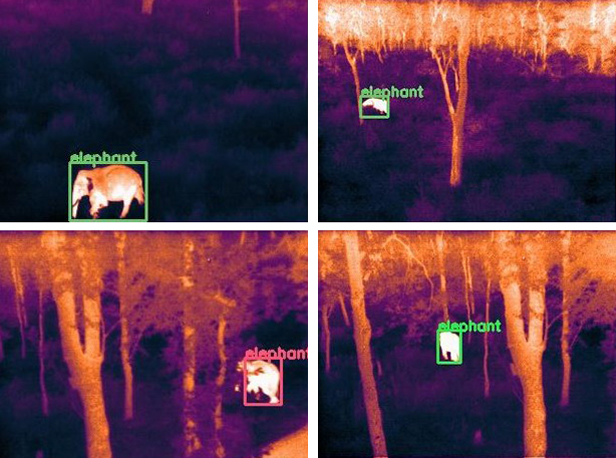
• Nighttime and all-weather detection: Thermal cameras, which detect the natural head emitted by bodies, can locate elephants in total darkness or in foggy conditions—where conventional cameras fail. By placing them in strategic locations, it is possible to monitor the elephants’ movements without disturbing them.
• Reduction of false positives: Unlike traditional motion sensors, which can be triggered by wind or small animals, thermal cameras clearly distinguish the massive silhouette and unique thermal signature of an elephant, thus limiting false alerts.
• Intrusion prevention: By installing thermal cameras near villages and crops, it is possible to anticipate the arrival of elephants and alert local communities in time. Early-warning systems, combined with sound or light barriers, help divert elephants before they reach populated areas.
2. A groundbreaking initiative in the field: very promising results
The example of the Gudalur Forest Division in the Nilgiris:
SMS Alerts that save lives.
This system was developed by OUTDU Mediatech Private Limited, an Indian technology company founded in 2003 and based in Bangalore. The company specializes in intelligent surveillance, operations, and response platforms based on artificial intelligence and real-time data analysis.
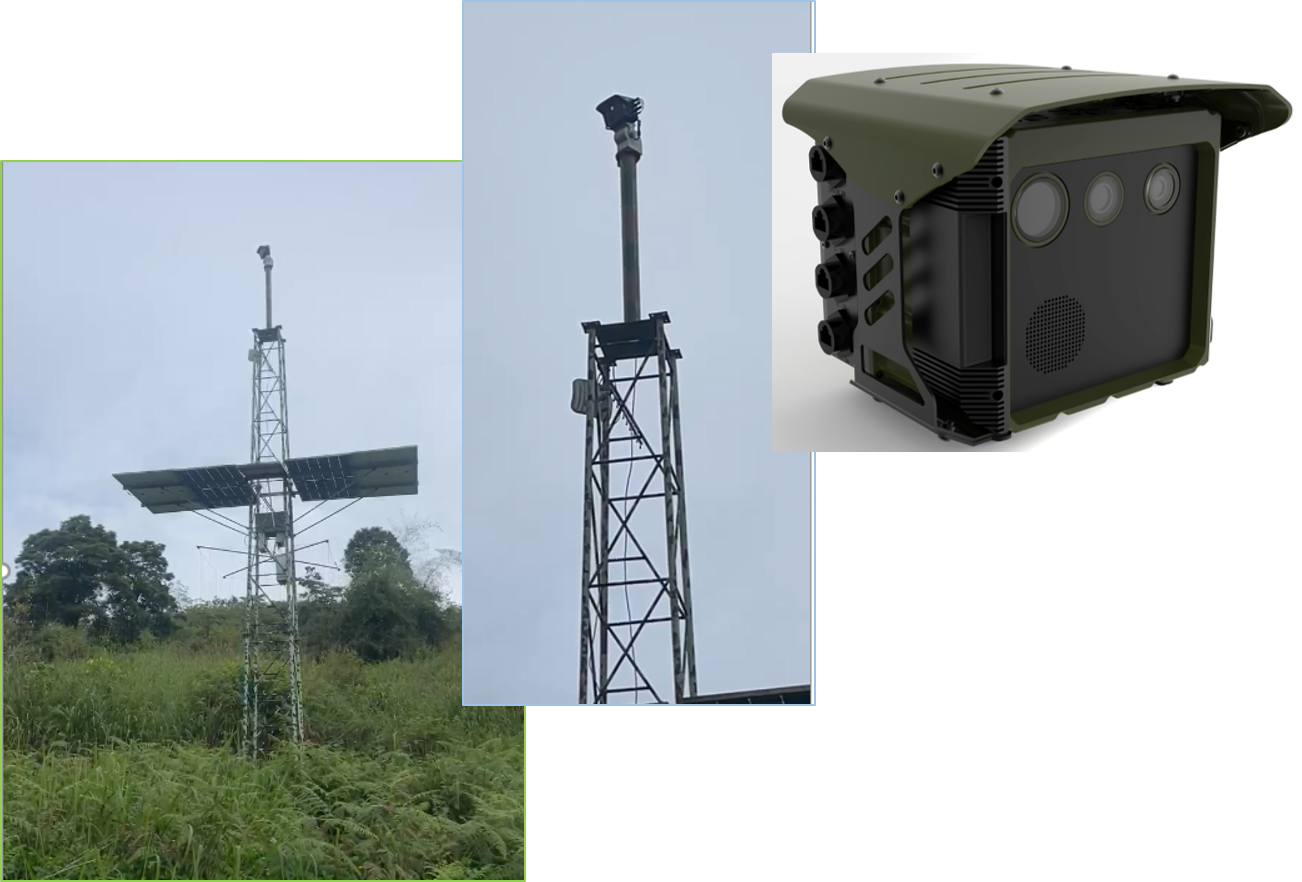
On December 20, 2025, the company inaugurated a new elephant movement monitoring system at Genepool Garden, in the Nadugani forest sector, as part of the Tamil Nadu Forest Force Modernization Program, at a total cost of €600,000.
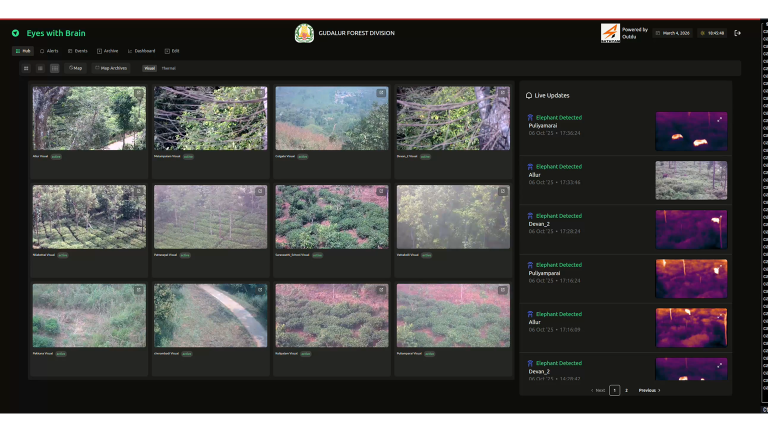
In just 4 months, the AI-based command and control center received 109 alerts regarding wild elephant movements, helping to save lives.
A Dedicated Team Serving Technology
This center operates 24/7 thanks to its six staff members working in shifts.
34 AI-equipped cameras cover 46 monitoring sites.
24 responders are stationed near residential areas prone to human-elephant conflicts. Information regarding elephant movements is broadcast via 24 loudspeakers installed near the most conflict-prone residential areas, enabling communities to receive real-time alerts.
In addition, 120 temporary agents, including anti-poaching watchers (APWs), are deployed throughout the Gudalur division with the sole purpose of guiding wild elephants back into the forest.
- Detection: AI-equipped cameras detect elephant movements
- Alert: The control center sends notifications to residents
- Return by vehicle: Forest guards guide elephants back to the forest
A Lifeline for Local Communities
This center has proven extremely useful for local residents, who now receive advance alerts about elephant movements on their cell phones. This allows them to stay safely at home rather than unknowingly approaching dangerous areas.
“I received a message on my cell phone at 9 p.m. informing me about elephant movements, just as I was planning to go to town for shopping. If I hadn’t received this alert, I would have been in big trouble. This alert allowed me to stay home and saved my life. ” — Ramesh, a resident of Kozhipalam, Gudalur.
“Since the AI-powered command and control center was set up and we started receiving alerts on our mobile phones, we’ve been able to move around safely wherever there’s no elephant activity.” — Ramesh, farmworker
Saving Both Humans and Elephants
A forest official emphasized that the center’s mission goes beyond ensuring people’s safety: “Thanks to the opening of this AI-based command and control center, we are saving both human lives and elephants.”
By enabling rapid interventions, the system prevents dangerous encounters that could harm both humans and wildlife, making it a model of coexistence in one of India’s most biodiverse regions.
A Recognized and Award-Winning Initiative
On March 10, 2026, N. Venkatesh Prabhu, the head of the Gudalur Forest Department, was awarded the DFO* Prize by Chief Minister M.K. Stalin in recognition of his outstanding work in reducing human-wildlife conflicts in the Gudalur division.
The Nilgiris’ AI-based command and control center marks a major breakthrough in the use of technology to protect both people and wildlife.
*DFO (District Forest Officers or Divisional Forest Officers) awards in India recognize Indian Forest Service (IFS) officers for their remarkable work in wildlife protection, sustainable forest management, and human-wildlife conflict resolution.
3. LYNRED at the Heart of These Initiatives
For 40 years, LYNRED has been a leading player in the field of infrared imaging. LYNRED designs and manufactures high-performance infrared detectors and modules that equip thermal imaging systems used in the most demanding environments.
Its expertise is based on comprehensive mastery of the design process, proven industrial capabilities, and recognized technical support.
Driven by its vision to “See Beyond the Horizons,” LYNRED offers a comprehensive range of infrared imagers covering the entire infrared spectrum (SWIR, MWIR, LWIR, VLWIR) through five different technologies (MCT, InGaAs, IGN, T2SL, and microbolometer).
It was only natural that LYNRED supported OUTDU Mediatech Private Limited in developing its model of human-wildlife coexistence by supplying detectors.
4. A Glimmer of Hope
The use of thermal cameras for elephant monitoring in India represents a significant step forward in conservation efforts. By providing a non-invasive and effective method for monitoring these majestic animals, this technology contributes not only to the protection of elephants but also to the preservation of biodiversity as a whole. It helps reduce risks and save lives.
Thermal cameras, as a conservation tool, show that it is possible to reconcile modern technology and nature conservation, offering hope for the future of elephants in India.